This site has limited support for your browser. We recommend switching to Edge, Chrome, Safari, or Firefox.
00 Days 00 Hours 00 Minutes 00 Seconds

30% OFF EVERYTHING w/ code: OFFGRID

Hard Summer Outfits

Filters

No filters available for this collection


Shop Hard Summer Festival Outfits

Our Hard Summer collection covers bodysuits, catsuits, jumpsuits, shorts and skirt sets, dresses and separates, sizes XS to XXL. This is a two-day festival in inland Southern California at the hottest point of the year, and unlike the night-only events it gets compared to, gates open during the day. You'll be in direct sun through the hottest hours before the night sets start. Heat management is the priority here, and it's a different problem to the one most rave outfit advice solves.

Daytime Heat Is the Actual Challenge

Most rave festival advice assumes you're dressing for a cold night. Hard Summer inverts that, and it's the mistake people make when they reuse an EDC outfit here.

The event runs in late July or early August, and inland Southern California in that window regularly exceeds a hundred degrees during the afternoon. There's little natural shade at most venues, and the crowd density adds to it. The hours between gates and sunset are the hardest part of the day, not the easiest.

Nights do cool off, but nowhere near as dramatically as a desert or mountain festival. You'll want something light for the late sets rather than genuine warmth, which means you can pack considerably lighter than you would for EDC or Bass Canyon.

The practical upshot: prioritise the daytime outfit and treat the evening layer as a minor addition. See breathable two piece sets.

Airflow Beats Coverage in This Heat

Inland SoCal is dry rather than humid, which means sweat evaporates and cools you properly. That changes what works compared to a Florida or Midwest festival.

Two approaches both work. Minimal coverage maximises exposed skin for evaporation and is the obvious choice. Lightweight loose coverage blocks direct sun while still allowing airflow underneath, which can leave you cooler than bare skin in genuinely intense sun.

What fails is anything in between: fitted synthetic with no airflow, dark heavy fabric, or vinyl. Those trap heat without offering sun protection, which is the worst of both.

Mesh is the strongest compromise, giving sun coverage and ventilation at once. See mesh festival bodysuits and standout festival wear.

Sun Exposure Across Two Full Days

Sunburn is the practical risk here in a way it isn't at night-only events, and it compounds across the second day.

Sunscreen applied at gates has largely worn off by mid-afternoon, and almost nobody reapplies as often as needed once they're in a crowd. Fabric coverage is more consistent, which makes a lightweight long sleeve or a mesh layer genuinely useful during the afternoon even if you take it off later.

Shoulders, upper back and chest burn first and are hardest to reach. Day two on burnt skin is miserable, and it's the single most common thing that ruins a weekend at a hot daytime festival.

Tan lines are worth thinking about too, since two days in the same cut leaves sharp marks. Some people stay consistent across both days rather than mixing cuts. See bright pink festival wear and yellow rave wear, both of which read well in strong daylight.

A Bass and Hip Hop Crowd

Hard Summer programmes heavy bass, hip hop and harder electronic rather than a broad or melodic lineup, and the fashion reflects it.

The aesthetic skews streetwear-influenced and harder-edged than a trance or house festival. More black, more neon-on-dark, more structured pieces, and less pastel or fairycore. Fuzzy boots, bandanas and oversized layers show up alongside the standard rave kit.

For that direction, see baddie festival wear and black rave wear. In a crowd wearing a lot of dark colours, a single strong neon against black stands out more than full multicolour does.

Two Sets of Lighting Conditions

Because the festival runs day into night, your outfit gets seen under two completely different lighting setups, and what works in one doesn't necessarily work in the other.

Daytime is neutral bright light. Bold colours and prints read at full strength, and this is when a multicolour design looks as designed. See multicolour rave wear and psychedelic rave wear.

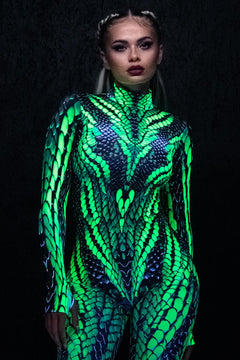
Night brings heavy production with blacklight, lasers and LED. Fluorescent pieces activate properly here. Neon green is the brightest option under UV since human vision peaks in that wavelength, and purple works reliably because blacklights emit visible violet that purple reflects directly. See neon green festival wear and purple rave wear.

A piece that works in both is one with fluorescent colour that also reads bold in daylight. Deep tones look sharp during the day and disappear at night.

What We Stock for Hard Summer

  • Shorts sets: The most practical daytime option, with maximum exposed skin for evaporation.

  • Bodysuits: Nothing shifts through a long day, though mesh versions handle the heat far better than solid ones.

  • Mesh layers: Sun coverage plus airflow, which is the specific combination that works in dry heat.

  • Skirt sets: Movement in the lower half and good airflow.

  • Dresses: Shorter lengths, since ground gets dusty and long hems are impractical.

  • Separates: Useful across two days for mixing rather than packing two full outfits.

Fabric for Extreme Dry Heat

  • Mesh: The most useful fabric at this event, providing shade and ventilation simultaneously.

  • Polyester blends: Wicking works properly in dry air, so sweat moves to the surface and evaporates. Also dries fast and sheds dust.

  • Spandex: For fitted pieces, though heat relaxes elastane across a long hot day, so a set can loosen noticeably by evening.

  • Avoid vinyl and wet-look: No breathability at all, and it becomes genuinely uncomfortable above ninety degrees.

  • Avoid velvet: Dense and warm, and the wrong call at the hottest festival on our list.

  • Avoid cotton: It absorbs sweat and holds it, so it stays wet through the afternoon rather than drying between sets.

Care Between Days

Two consecutive days of heavy sweat plus sunscreen is hard on synthetic fabric, and both accumulate on anything sitting against skin.

Sunscreen and body oil break down elastane, and you'll be applying more of both here than at a night event. A cold rinse at the end of day one removes most of it, and in dry SoCal air pieces dry overnight easily.

Don't leave worn pieces sealed in a bag between days. Warm damp synthetic fabric develops odour fast in this heat.

Once home: cold water, inside out, no fabric softener on stretch pieces since it reduces recovery, and no dryer on spandex blends. A white vinegar soak clears body oils that detergent alone doesn't always shift.

Accessories

Sun protection is the priority rather than an afterthought. Proper sunglasses, a hat if you can keep track of it, and high-SPF sunscreen you actually reapply. Lip balm with SPF, since lips burn and nobody thinks about it.

Water matters more here than at a cooler festival. Dry heat plus dancing dehydrates fast, and a hydration pack or bottle affects what bag you carry. A small backpack over a fanny pack for that reason.

Closed shoes for dusty ground and crowds, broken in beforehand. LED accessories and UV body paint earn their place for the night sets. Glitter holds well in dry air, though sweat lifts it during the afternoon, so it's better applied for the evening than at gates.

Other Festivals

For other heavy bass events with similar crowds, see Bass Canyon rave wear, Basscon Wasteland festival wear and Wobbleland rave wear.

For other Southern California events, Beyond Wonderland festival wear and CRSSD rave wear, which runs considerably cooler on the coast.

For night-only desert events where cold rather than heat is the problem, EDC festival wear. For other summer events, Imagine Festival rave wear and Ultra Music festival wear.

Hard Summer Outfit Questions & Answers

See what we get asked below.

What should I wear to Hard Summer?

Something built for daytime heat first, with a light layer for the night sets. Unlike night-only festivals, gates open during the hottest part of the afternoon in one of the hottest months, so heat management matters more than warmth. Mesh gives you sun coverage and airflow at the same time.

How hot does Hard Summer get?

Inland Southern California in late July and early August regularly exceeds a hundred degrees, with little natural shade and a dense crowd adding to it. The hours between gates and sunset are the hardest part of the day. Nights cool off but not dramatically, so you won't need real warmth.

Do I need a jacket for the night?

Something light rather than genuinely warm. Southern California summer nights don't drop the way desert or mountain nights do, so a mesh layer or thin long sleeve is usually enough. That means you can pack considerably lighter than for EDC or a camping festival.

Should I cover up or wear less in the heat?

Both work in dry heat. Minimal coverage maximises evaporation, while lightweight loose coverage blocks direct sun and still allows airflow. What fails is anything in between: fitted synthetic with no ventilation, dark heavy fabric, or vinyl, which trap heat without offering sun protection.

What glows at the night sets?

Fluorescent pinks, greens and yellows react strongly under blacklight, with neon green the brightest since human vision peaks in that wavelength. Purple is reliable too, as blacklights emit visible violet that purple reflects directly. Deep tones look sharp in daylight and disappear once the sun goes down.

Sizing

Sizes run XS to XXL. Fit depends on the garment, so check the size chart on each product page. One thing specific to a hot festival: heat relaxes elastane over a long day, so a fitted set can loosen noticeably by evening. On strapless cuts, size down if you're between sizes, since band grip does the holding and it loosens further in the heat.

Your new look is practically in the bag. Don’t leave it hangin’!

Cart

No more products available for purchase